 ultimate-guide
Low Shedding Goldendoodle Puppy Breeds: A 2026 Guide
Table of Contents
- Do Goldendoodles Shed? Understanding the Reality
- Are Goldendoodles Hypoallergenic for Allergies
- Coat Types and Shedding: Curly, Wavy, and Straight Coats
- F1 vs F1b Goldendoodle Coat Types: Which Sheds Less
- How to Groom a Low Shedding Goldendoodle
- Puppy Coat Transition and What to Expect
- Choosing a Low Shedding Goldendoodle: What Matters Most
- Frequently Asked Questions
Last Updated: September 2, 2026
Do Goldendoodles Shed? Understanding the Reality
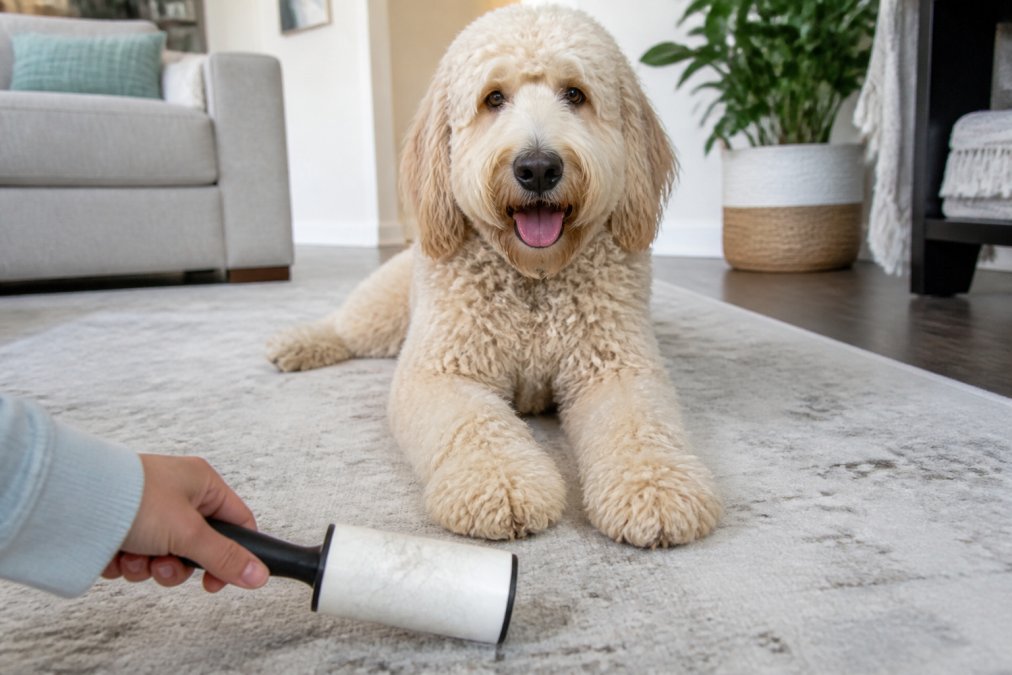
Yes, Goldendoodles do shed, though the amount varies significantly depending on their coat type and genetics. This is the uncomfortable truth that many prospective owners don't hear until after they've committed to bringing a puppy home. A low shedding goldendoodle is possible, but it's not guaranteed, and understanding why requires looking at the genetics behind the breed.
Goldendoodles are a cross between Golden Retrievers and Standard Poodles. Golden Retrievers shed heavily year-round (akc.org). Poodles have hair, not fur, and shed minimally (akc.org). When you breed these two together, the offspring's coat can inherit traits from either parent or somewhere in between. This unpredictability is why some Goldendoodles are genuinely low-shedding while others shed enough to frustrate allergy sufferers and vacuum-weary owners alike.
The shedding you'll experience depends on three main factors: coat type (curly, wavy, or straight), generation (F1, F1b, or F2), and individual genetics. At Blue Ridge Doodles, we prioritize genetics and selective breeding to increase the likelihood of lower-shedding puppies, but transparency matters here, no responsible breeder can guarantee zero shedding.
Are Goldendoodles Hypoallergenic for Allergies
Goldendoodles are not truly hypoallergenic, despite what breeders often claim. The term itself is misleading, no dog is completely hypoallergenic because all dogs produce allergens through dander, saliva, and urine. What matters is whether a dog produces fewer allergens than others.
A Poodle's hair-based coat (as opposed to fur) sheds less frequently and produces less dander than a Golden Retriever's double coat (akc.org). When you breed a Poodle with a Golden Retriever, you get a dog that may inherit the Poodle's lower-shedding coat. That said, genetics don't always cooperate. Some Goldendoodles inherit the Golden Retriever's shedding tendency despite having a Poodle parent.
If you have allergies, the real question isn't whether Goldendoodles are hypoallergenic, it's whether this specific puppy will trigger your symptoms. Before committing to a Goldendoodle, spend time with the breed. Many families discover that a puppy's coat works well for their allergies only after living with it for a few weeks. This is where allergy testing before adoption becomes valuable. Some people test their own allergic response by visiting breeders or spending time with adult Goldendoodles first.
Dander management also plays a role. Regular grooming, bathing, and brushing reduce the amount of loose hair and dander circulating in your home. A dog with a lower-shedding coat still requires consistent maintenance to minimize allergen exposure.
Coat Types and Shedding: Curly, Wavy, and Straight Coats
The three coat types in Goldendoodles, curly, wavy, and straight, have dramatically different shedding profiles and grooming demands.
Curly coats are the most sought-after for low shedding. The hair grows in tight, uniform curls that trap shed hair within the coat rather than releasing it into your home. A curly-coated Goldendoodle sheds minimally, making it the best option for allergy sufferers or owners who prioritize cleanliness. The trade-off is grooming intensity. Curly coats mat easily and require professional grooming every 6-8 weeks, plus regular brushing at home.
Wavy coats fall somewhere in the middle. They have a loose, undulating texture that's less prone to matting than curly coats but sheds more than curly. Wavy-coated dogs still require regular grooming, typically every 8-10 weeks, but the maintenance burden is lighter. Many families find wavy coats offer the best balance between low shedding and manageable grooming.
Straight coats inherit more from the Golden Retriever side genetically. These coats shed noticeably more than curly or wavy coats and require less frequent professional grooming, though they still benefit from regular brushing. If you have allergies, a straight-coated Goldendoodle is less likely to meet your needs.
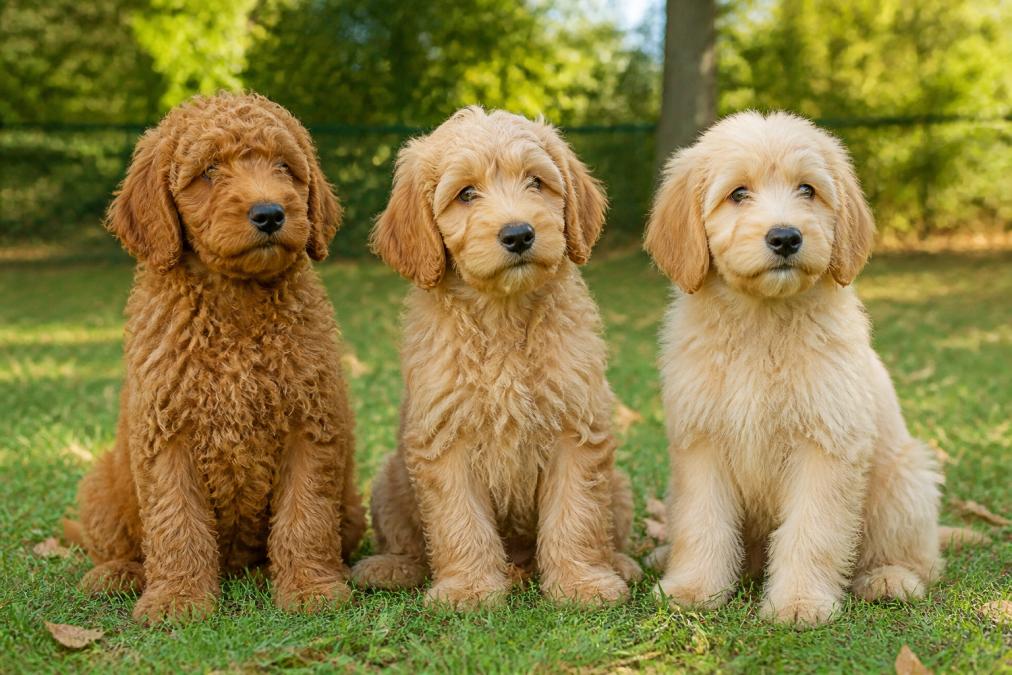
The coat type you get depends partly on genetics and partly on luck. Even within the same litter, puppies can have different coat textures. Responsible breeders like Blue Ridge Doodles assess coat type early and provide honest descriptions to prospective owners. A breeder who can't tell you whether a puppy has a curly, wavy, or straight coat at 8 weeks isn't paying close attention.
F1 vs F1b Goldendoodle Coat Types: Which Sheds Less
Understanding Goldendoodle generations is essential to predicting shedding and coat quality. The "F" designations refer to filial generations, how many generations removed from the purebred parents.
F1 Goldendoodles are first-generation crosses: one purebred Golden Retriever parent and one purebred Standard Poodle parent. F1 puppies are genetically 50% Golden Retriever and 50% Poodle. This generation is unpredictable. Some F1 Goldendoodles inherit the Poodle's low-shedding coat; others inherit the Golden Retriever's heavy shedding. Coat type varies widely within an F1 litter, and you won't know for certain until the puppy matures.
F1b Goldendoodles are backcrosses: an F1 Goldendoodle bred back to a purebred Poodle. F1b puppies are 75% Poodle and 25% Golden Retriever. This generation tends toward lower shedding and more consistent coat type because the Poodle genetics are dominant. If low shedding is your priority, F1b is statistically more reliable than F1.
F2 Goldendoodles (F1 bred to F1) are less predictable than F1b because you're combining two dogs with mixed genetics. Shedding and coat type can vary widely.
The relationship between generation and shedding isn't absolute, an F1 with curly coat furnishings can shed less than an F1b with a straighter coat. Furnishings refer to the facial hair that gives Doodles their characteristic teddy-bear appearance. Dogs with furnishings tend to have lower-shedding coats. When evaluating a puppy, ask the breeder about both generation and furnishings, not just the "F" designation.
How to Groom a Low Shedding Goldendoodle
Grooming is non-negotiable for low-shedding Goldendoodles. Without it, even a curly-coated dog will mat, and matting can trap dander and create skin issues. The grooming routine depends on coat type, but consistency is universal.
For curly-coated Goldendoodles, professional grooming every 6-8 weeks is essential. Between appointments, brush your dog 3-4 times per week with a slicker brush and metal comb to prevent mats. Pay special attention to areas that mat easily: behind the ears, under the armpits, and around the rear end. Daily brushing during shedding seasons (spring and fall) helps manage loose hair before it becomes a matting problem.
For wavy-coated Goldendoodles, professional grooming every 8-10 weeks is typically sufficient, with brushing 2-3 times per week at home. Wavy coats are more forgiving than curly coats but still require attention.
For straight-coated Goldendoodles, professional grooming every 10-12 weeks works, and brushing once or twice weekly helps manage shedding. Straight coats shed more noticeably, so more frequent brushing reduces the amount of loose hair in your home.
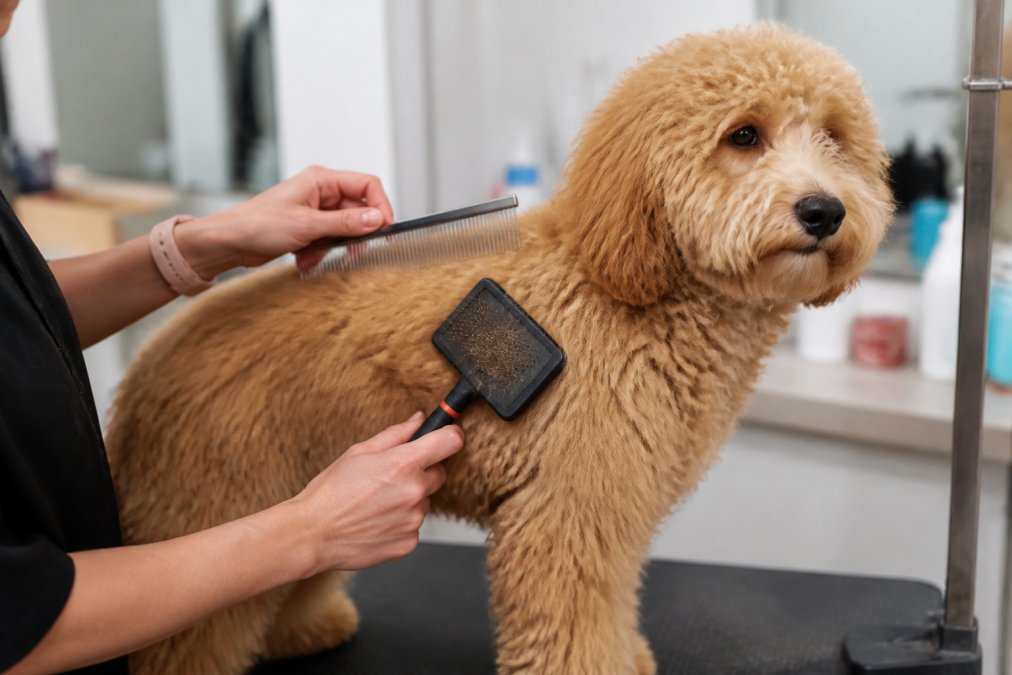
Bathing every 4-6 weeks with a quality dog shampoo supports coat health and reduces loose hair. Some owners use a high-velocity dryer after bathing to blow out loose undercoat, which significantly reduces shedding. This technique is particularly effective during seasonal transitions.
Many families underestimate grooming costs. Professional grooming for a Goldendoodle typically ranges based on coat type and your location, but it's a recurring expense that shouldn't be a surprise. Budget accordingly before bringing a puppy home. The alternative, skipping grooming, leads to matted coats, skin problems, and a dog that's uncomfortable.
Puppy Coat Transition and What to Expect
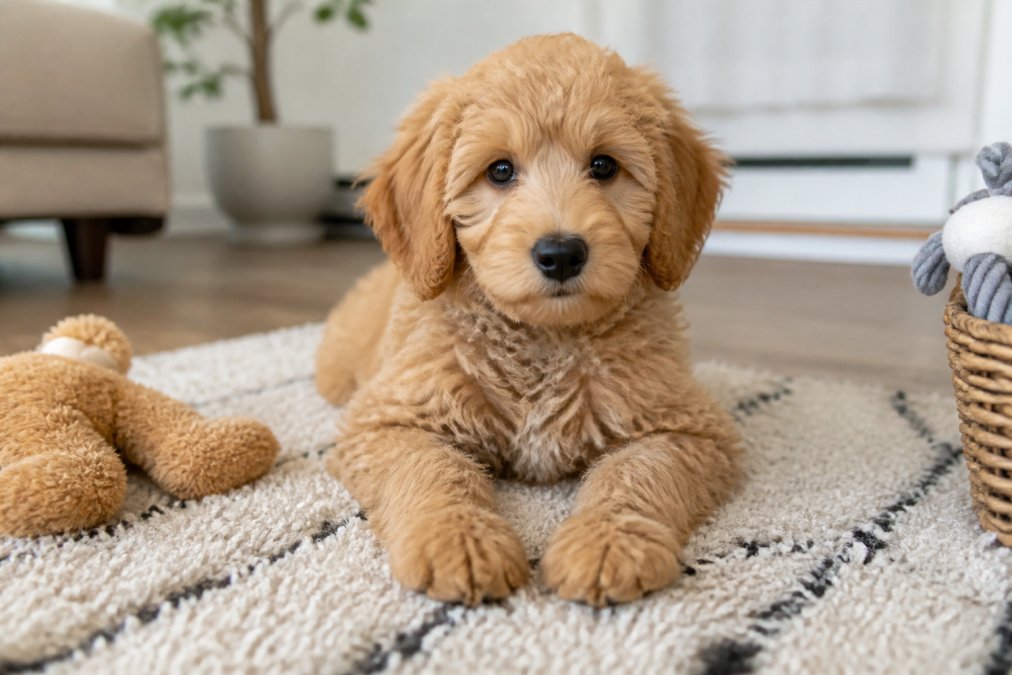
Most Goldendoodle puppies are born with soft, fluffy puppy coats that look nothing like their adult coats. Between 4-12 months of age, puppies transition to their adult coat, and this is when the reality of shedding becomes apparent.
During the puppy coat transition, shedding increases dramatically. You'll see loose hair everywhere, on furniture, clothing, and in your vacuum. This temporary phase can last several weeks and is often a shock to owners who didn't expect it. A puppy with a curly coat at 8 weeks might have a wavy coat at 6 months and a fully curly coat at 12 months. Coat texture, density, and color can all shift during this window.
The transition period is also when you'll get your first real sense of whether your puppy's coat will truly be low-shedding. If you have allergies, this is when you'll know whether the puppy is a good fit for your household. Some families discover during the transition that their puppy sheds more than expected and decide to return the puppy, which is why choosing a breeder with transparent return policies matters.
During the transition, increase brushing frequency to manage loose hair. Daily brushing is common during heavy shedding phases. Some owners find that professional grooming during the transition helps remove loose puppy coat more efficiently than home brushing alone.
Choosing a Low Shedding Goldendoodle: What Matters Most
Selecting a puppy from a breeder who prioritizes low-shedding genetics makes a real difference. Not all breeders invest equally in coat quality and shedding predictability.
Ask the breeder about parent coat types and shedding history. A responsible breeder can tell you the coat type and shedding level of both parents and explain how those traits influence the litter. If a breeder can't describe the parents' coats in detail or dismisses shedding as "not a big deal," that's a red flag.
Request honest coat assessments at 8 weeks. A good breeder evaluates each puppy's coat type early and communicates what they observe. Curly coats are usually evident by 8 weeks. Wavy and straight coats may take longer to fully develop, but a breeder should give you their best assessment and realistic expectations.
Prioritize breeders who provide health guarantees and support. A two-year limited health warranty demonstrates confidence in the puppy's quality and gives you recourse if genetic issues emerge. Blue Ridge Doodles includes health certificates, vet checks, and ongoing support because we stand behind our puppies.
Ask about the breeder's experience with allergies. Have they worked with allergy-sensitive families? Can they describe how their puppies have performed in homes with mild allergies? A breeder with real experience can give you honest feedback rather than generic reassurance.
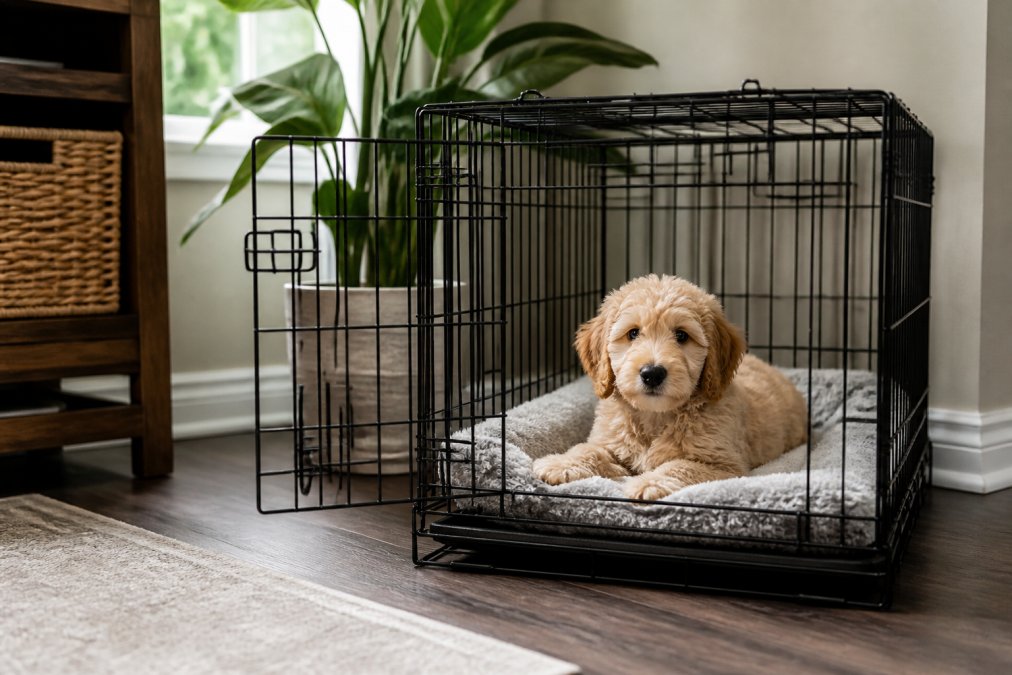
Consider the puppy's early environment. Puppies raised in family homes with socialization and crate training often adapt better to grooming routines and handling. A well-socialized puppy from Blue Ridge Doodles is more likely to tolerate the brushing and professional grooming that low-shedding coats require.
Evaluate breeder transparency about costs. Low-shedding Goldendoodles from quality breeders cost more than puppies from casual breeders or puppy mills. That cost reflects better genetics, health screening, socialization, and ongoing support. If a breeder's pricing seems suspiciously low compared to others, investigate their practices carefully.
| Factor | Why It Matters | What to Ask |
|---|---|---|
| Parent coat types | Determines genetic predisposition to shedding | "What are both parents' coat types and shedding levels?" |
| Generation (F1 vs F1b) | F1b tends toward more consistent low shedding | "Is this an F1, F1b, or F2 puppy?" |
| Furnishings | Dogs with furnishings typically shed less | "Does this puppy have furnishings?" |
| Health guarantee | Protects you if genetic issues emerge | "What does your health warranty cover and for how long?" |
| Breeder experience | Experienced breeders make better predictions | "How many litters have you bred, and what's your track record?" |
| Socialization | Well-socialized puppies adapt better to grooming | "How are puppies socialized before going home?" |
Choosing a low shedding goldendoodle puppy requires patience and honest conversations with breeders. The reality is that genetics matter, coat type matters, and grooming commitment matters. There's no perfect, zero-shedding Goldendoodle, but there are puppies bred specifically for lower shedding and raised by breeders who understand the commitment required.
At Blue Ridge Doodles, we've spent over 18 years refining our breeding practices to prioritize low-shedding coats, healthy temperaments, and family compatibility. Every puppy receives three weeks of crate training, two rounds of booster vaccines, microchipping, and a two-year limited health warranty. Our puppies are vet-checked and raised in a family environment where they learn to bond with people and adapt to household routines. When you bring a Blue Ridge Doodles puppy home, you're not just getting a dog, you're getting a partner committed to your puppy's success and your family's peace of mind.
Ready to find your low-shedding Goldendoodle? Start with an application to Blue Ridge Doodles and let's discuss which puppy might be the right fit for your family.
Frequently Asked Questions
Which Goldendoodle generation sheds the least?
F1b Goldendoodles (75% Poodle, 25% Golden Retriever) typically shed the least due to higher Poodle genetics. F1 Goldendoodles (50/50 mix) shed moderately and vary more by individual coat type. Breeder transparency about parent coat types helps predict your puppy's shedding level.
Are Goldendoodles truly hypoallergenic for allergies?
No dog is completely hypoallergenic, but low shedding Goldendoodles produce less dander and shed less hair, which can reduce allergy triggers for some people. Curly-coated Goldendoodles trap more hair and dander in their coat rather than releasing it into your home. If allergies are severe, spend time with the specific puppy before adoption and consider allergy testing to confirm compatibility.
How often do low-shedding Goldendoodles need grooming?
Low shedding Goldendoodles need professional grooming every 6-8 weeks and daily brushing at home to prevent matting. Curly coats require more frequent maintenance than wavy coats. Skipping grooming leads to painful mats and skin issues. Regular brushing also helps manage loose hair and dander, making the coat healthier and reducing allergen spread.
What should I look for in a breeder to ensure a low-shedding puppy?
Ask breeders about parent coat types, generation (F1b preferred for lower shedding), and genetic testing results. Request photos of parents' coats and ask about coat transitions in previous litters. Reputable breeders provide health warranties, vet checks, and transparency about shedding likelihood. Visiting a breeder to see how puppies are raised and socialized can also be helpful.