 ultimate-guide
How to Crate Train a Goldendoodle Puppy: Step-by-Step
Table of Contents
- Why Crate Training Matters for Your Goldendoodle
- Best Crate Size for Goldendoodles: Getting the Right Fit
- How to Crate Train a Goldendoodle Puppy: Step-by-Step
- Your Crate Training Schedule for Puppies: The First Two Weeks
- How to Stop Puppy Crying in Crate: A Practical Guide
- Crate Training at Night and Handling Setbacks
- Crate Training for Working Owners and Socialization
- Conclusion: Setting Your Puppy Up for a Lifetime of Success
- Frequently Asked Questions
Last Updated: September 4, 2026
Why Crate Training Matters for Your Goldendoodle
Crate training is the single most effective tool you have for raising a confident, well-mannered Goldendoodle puppy. It taps into a dog's natural den instinct, giving them a quiet, safe space to retreat to when the world feels overwhelming. For a breed as intelligent and people-oriented as the Goldendoodle, a crate prevents the anxiety-driven behaviors that often emerge when they are left to their own devices.
At BLUE RIDGE DOODLES, we see the difference daily. Puppies that arrive home with a solid crate foundation adapt faster, sleep through the night sooner, and bond more deeply with their families. We begin this process early, giving every puppy three weeks of crate training before they ever meet you. The goal is simple: your puppy should view the crate not as a cage, but as their bedroom.
This guide walks you through the exact methods we use. You will learn how to choose the right size, build a schedule that prevents accidents, and handle the inevitable whining without undoing your progress. We also cover the specific temperament challenges Goldendoodles bring to the table, so you can avoid the frustration most first-time owners hit.
The payoff is significant. A puppy who is comfortable in a crate is easier to housebreak, safer when you are away, and far less likely to develop the destructive habits that strain family life.
Best Crate Size for Goldendoodles: Getting the Right Fit
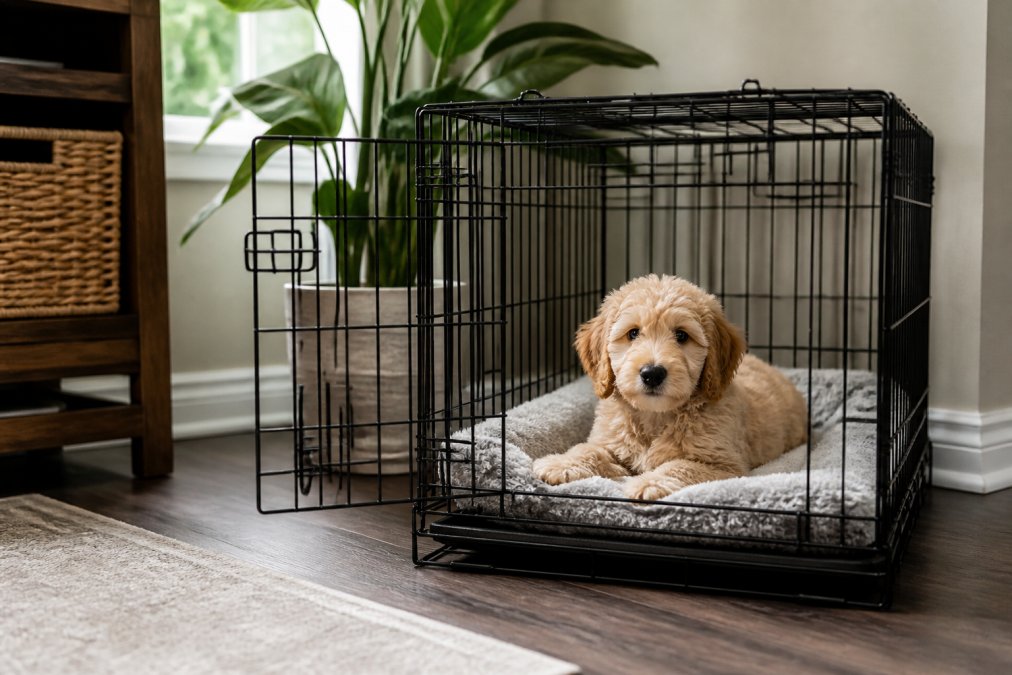
The best crate size for Goldendoodles is one that lets your puppy stand up, turn around, and lie down flat without extra room to spare. This is the golden rule of kennel training. A crate that is too large encourages your puppy to designate one corner as a bathroom, which undermines housebreaking entirely.
Most Goldendoodle puppies arrive home weighing between 8 and 15 pounds. A 24-inch crate fits them well initially, but a standard Goldendoodle will outgrow it within months. Purchasing an adult-sized crate (typically 36 to 42 inches for a standard, 30 inches for a mini) with a divider panel is the most economical approach. You adjust the panel as your puppy grows, maintaining that snug, den-like feel.
Wire Crates vs. Plastic Crates
Wire crates are the best choice for most Goldendoodle owners because they offer superior airflow, visibility, and easy cleaning. The open design also prevents the "escape artist" mentality some puppies develop when they feel enclosed. Plastic crates, by contrast, offer more security and are ideal for travel, but they run warmer and can feel isolating for a social breed like the Goldendoodle.
Regardless of style, skip the plush bedding initially. Puppies chew, and ingested fabric can cause serious blockages. A thin, washable mat or a towel works best until your puppy proves they will not destroy it. Place a durable chew toy inside to keep their jaws busy.
How to Crate Train a Goldendoodle Puppy: Step-by-Step
Crate training a Goldendoodle puppy works best when you treat it as a gradual introduction, not a sudden confinement. The process relies entirely on positive reinforcement and incremental training. Here is the sequence we use with every litter:
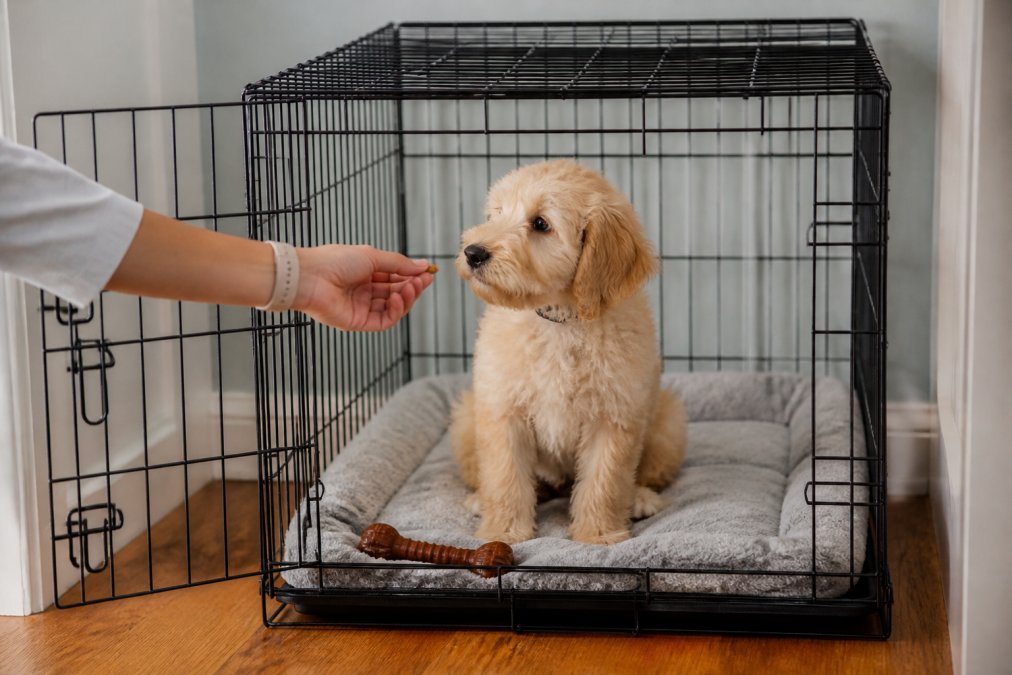
- Make the crate inviting. Leave the door open and toss high-value treats inside throughout the day. Let your puppy wander in and out freely. Do not close the door yet.
- Feed meals inside. Place the food bowl at the back of the crate. This builds a strong positive association. Once your puppy eats comfortably, close the door for the duration of the meal, then open it.
- Introduce a command. Say "kennel" or "bed" as your puppy enters, followed by a treat. Repeat this dozens of times until the word alone sends them inside.
- Close the door for short intervals. Start with 2 to 5 minutes while you sit nearby. Reward calm behavior with a treat through the wire. Gradually extend the time and increase your distance.
- Practice departures. Step out of sight for a minute, then return. Do not make a fuss when you leave or arrive. Keep it boring. This prevents separation anxiety from forming.
- Extend duration slowly. Add 5 to 10 minutes per session as your puppy succeeds. A good rule of thumb is that a puppy can hold their bladder for roughly one hour per month of age, up to a maximum of 8 hours for adult dogs.
Your Crate Training Schedule for Puppies: The First Two Weeks
A crate training schedule for puppies is only as good as your consistency. Goldendoodles are eager to please, but they thrive on structure. The first two weeks set the tone for everything that follows.
| Age | Max Crate Duration | Potty Breaks Needed | Best Practice |
|---|---|---|---|
| 8-10 weeks | 1-2 hours | Every 60-90 minutes | Take out immediately after naps, meals, and play |
| 10-12 weeks | 2-3 hours | Every 2 hours | Begin extending overnight stretches |
| 12-16 weeks | 3-4 hours | Every 3-4 hours | Add short departures to run errands |
| 16+ weeks | 4-6 hours | Every 4-5 hours | Most puppies can sleep through the night |
A typical day should look like this: wake up and go straight outside. Breakfast in the crate with the door closed. Potty break. A short play session. Back in the crate for a nap while you work. Repeat this cycle every 2 to 3 hours.
The key is to never let your puppy "hold it" past their physical limit. Every accident inside the crate is a regression that teaches them it is acceptable to eliminate where they sleep. If you cannot be home to maintain the schedule, set up a safe puppy-proofed area with a potty pad rather than leaving them crated too long.
How to Stop Puppy Crying in Crate: A Practical Guide
Puppy crying in the crate is normal, but how you respond determines whether it lasts three days or three weeks. The first step is to determine the cause. Is it a potty emergency, or is it attention-seeking?
If your puppy has just been out and you know they are empty, the crying is likely a protest. Responding by letting them out teaches them that crying works. Instead, wait for a moment of silence, even if it lasts only two seconds, then reward that quiet with calm praise through the crate door. You are reinforcing the behavior you want, not the whining.
For genuine potty needs, take your puppy out on a leash, keep it quiet and boring, and return them to the crate immediately after they eliminate. No playtime reward for crying. This distinction is critical for housebreaking success.
Goldendoodles are particularly prone to crying because they are so bonded to their people. They do not cry because they dislike the crate; they cry because they want to be with you. The American Kennel Club's guide on puppy crate training notes that ignoring attention-seeking whining is the fastest path to a quiet crate, provided the puppy's basic needs are met.
Crate Training at Night and Handling Setbacks
Crate training at night follows a slightly different rhythm. Place the crate in your bedroom for the first few weeks. Your puppy can hear, smell, and see you, which dramatically reduces nighttime anxiety. This proximity also lets you hear when they stir, which is your cue to take them out before an accident happens.
Set an alarm for a middle-of-the-night potty break based on your puppy's age. For an 8-week-old, that is roughly every 3 hours. Keep the lights low, the interaction minimal, and return to the crate immediately after. Within a few weeks, you can extend the interval and eventually move the crate to its permanent location.
What to Do About Regression
Regression happens. A puppy who slept through the night for a week suddenly starts whining at 2 a.m., or a previously calm crate becomes a source of stress. Before you assume a behavioral problem, rule out the physical ones: a urinary tract infection, a dietary change, or a growth spurt that requires more frequent elimination.
If your puppy is healthy, regression is often tied to a change in routine or a period of overstimulation. The fix is to step backward in your training. Return to shorter crate sessions, move the crate closer to you at night, and rebuild the positive associations with treats and meals. Consistency and patience will resolve most regressions within a few days. It is a setback, not a failure.
Crate Training for Working Owners and Socialization
Crate training for working owners requires a plan that protects both your puppy's bladder and your sanity. If you are away for a standard 8-hour workday, a young puppy cannot physically hold it that long. You need a midday break, either from a neighbor, a dog walker, or a return home during your lunch hour.
For the hours your puppy is alone, create a routine that burns mental energy before confinement. A 15-minute walk, a puzzle toy, and a training session will leave your puppy tired and ready to nap, rather than anxious and looking for trouble. Crate games and enrichment, like hiding treats inside a stuffed Kong, turn the crate into a rewarding destination.
Socialization continues alongside crate training. A well-socialized Goldendoodle is exposed to new people, sounds, and surfaces while still young. The American Veterinary Society of Animal Behavior's puppy socialization position statement emphasizes that the critical socialization window closes by 14 to 16 weeks, so do not delay introductions. Use the crate as a calm observation point where your puppy can watch the household bustle without being overwhelmed.
Goldendoodles are social butterflies by nature. The Goldendoodle Association of North America's breed information describes them as highly sociable dogs that thrive on human interaction. That makes your job easier: a tired, mentally stimulated Goldendoodle is far more content to settle in their crate than one that has been ignored all day.
Conclusion: Setting Your Puppy Up for a Lifetime of Success
Raising a Goldendoodle puppy is a marathon, not a sprint. The first few weeks of crate training will test your patience, but the structure you build now pays dividends for the next 12 to 15 years. A puppy who sees their crate as a safe space grows into an adult dog who handles alone time gracefully, travels well, and recovers from stress quickly.
If you are just starting your search, choose a breeder who has already laid this foundation. At BLUE RIDGE DOODLES, every puppy receives three weeks of crate training, is socialized in a family environment, and comes with a two-year limited health warranty for your peace of mind. You are not just buying a puppy; you are gaining a partner in the training process who wants to see you succeed.
Get started with BLUE RIDGE DOODLES and bring home a puppy who is already one step ahead in their training journey.
Frequently Asked Questions
How long should I let my Goldendoodle puppy cry in the crate the first night?
On the first night, you should not let your puppy cry indefinitely. Respond to crying that lasts more than 10-15 minutes by taking your puppy outside for a quick potty break. If they eliminate, give quiet praise and return them to the crate. If they cry again shortly after, they may just need comfort. A shirt that smells like you placed near the crate can help them settle.
At what age is a Goldendoodle typically fully crate trained?
Most Goldendoodle puppies are reliably crate trained by 4 to 6 months of age. This timeline depends on your consistency with the crate training schedule for puppies. By this age, they have better bladder control and understand the crate as their safe space. Puppies from breeders who start early, like Blue Ridge Doodles with their three-week head start, often adapt faster in their new home.
How big of a crate for a Goldendoodle?
The best crate size for Goldendoodles is one that lets them stand up, turn around, and lie down comfortably. For a standard Goldendoodle, a 36-inch or 42-inch wire crate is usually ideal for adulthood. Start with a 24-inch or 30-inch crate for a puppy and use a divider panel to block off extra space, which is essential for housebreaking.
What if my puppy has an accident in the crate during the night?
If your puppy has an accident in the crate, stay calm and clean it thoroughly with an enzymatic cleaner to remove the odor. This prevents them from returning to the same spot. Review your schedule; your puppy may need a later bedtime potty break or an earlier wake-up call. Never punish your puppy for accidents, as this creates fear and can make crate training harder.