 ultimate-guide
Benefits of Choosing a Family-Raised Goldendoodle
Table of Contents
- What 'Family-Raised' Actually Means for a Goldendoodle Puppy
- Temperament and Behavioral Development in a Home Environment
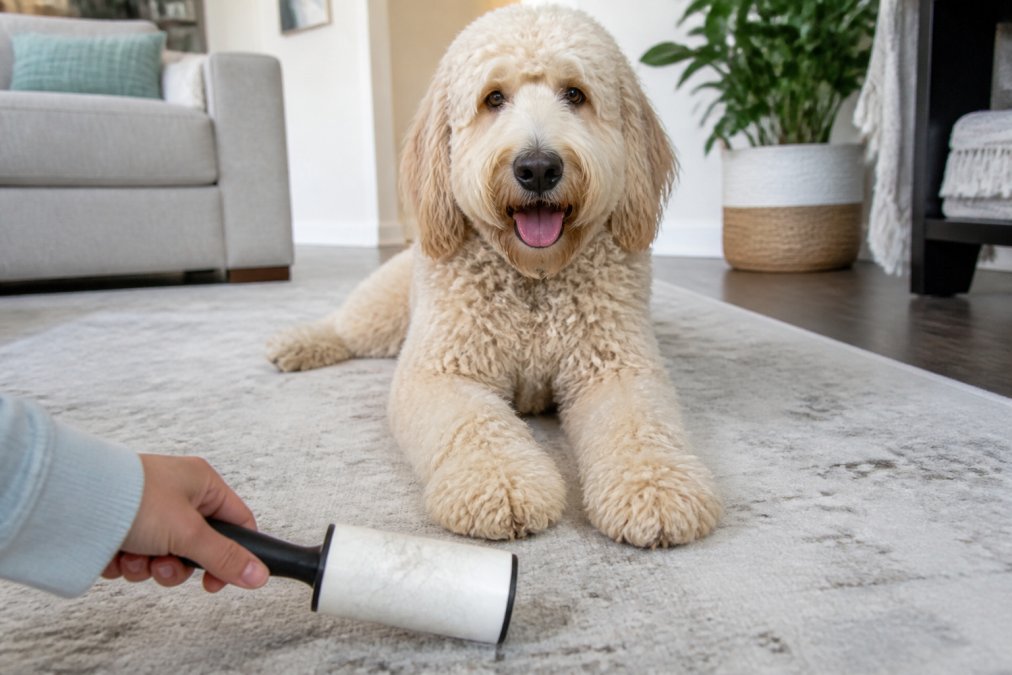
- Hypoallergenic Qualities and the Low-Shedding Coat
- Crate Training a Goldendoodle Puppy Before You Bring Them Home
- Understanding Your Goldendoodle Puppy Health Warranty
- Questions to Ask a Goldendoodle Breeder Before You Commit
- Why a Family-Raised Goldendoodle Is the Right Choice for Your Home
- Frequently Asked Questions
Last Updated: August 28, 2026
The benefits of choosing a family-raised Goldendoodle go far beyond a cute face and a low-shedding coat. At Blue Ridge Doodles, we've spent over 18 years watching families transform when a well-socialized, home-raised puppy walks through their door. The difference between a home-raised puppy and one from a commercial facility is real, measurable, and shapes the dog's behavior for life.
What 'Family-Raised' Actually Means for a Goldendoodle Puppy
A family-raised Goldendoodle grows up inside a home environment from birth, not in a kennel, barn, or commercial facility. Puppies raised in a home are exposed daily to dishwashers, doorbells, children, television, and vacuum cleaners, all become normal background noise rather than sources of fear. This household desensitization begins in the first weeks of life, long before a puppy's fear response fully develops.
By contrast, puppies raised in commercial environments often experience the world as a series of surprises when they arrive in a family home, triggering anxiety that manifests as excessive barking, destructive behavior, or difficulty bonding.
A family-raised environment also means the puppy is handled frequently by multiple people, including children. According to the American Kennel Club's puppy development guidelines, early and varied human contact during the socialization window, roughly three to twelve weeks of age, has lasting positive effects on a dog's ability to form trusting relationships throughout its life.
Temperament and Behavioral Development in a Home Environment
Goldendoodle temperament is shaped by genetics and environment. Genetics sets the range of possible outcomes; environment determines where within that range the dog lands. A home-based upbringing pushes that outcome toward the calm, confident, and affectionate end of the spectrum.
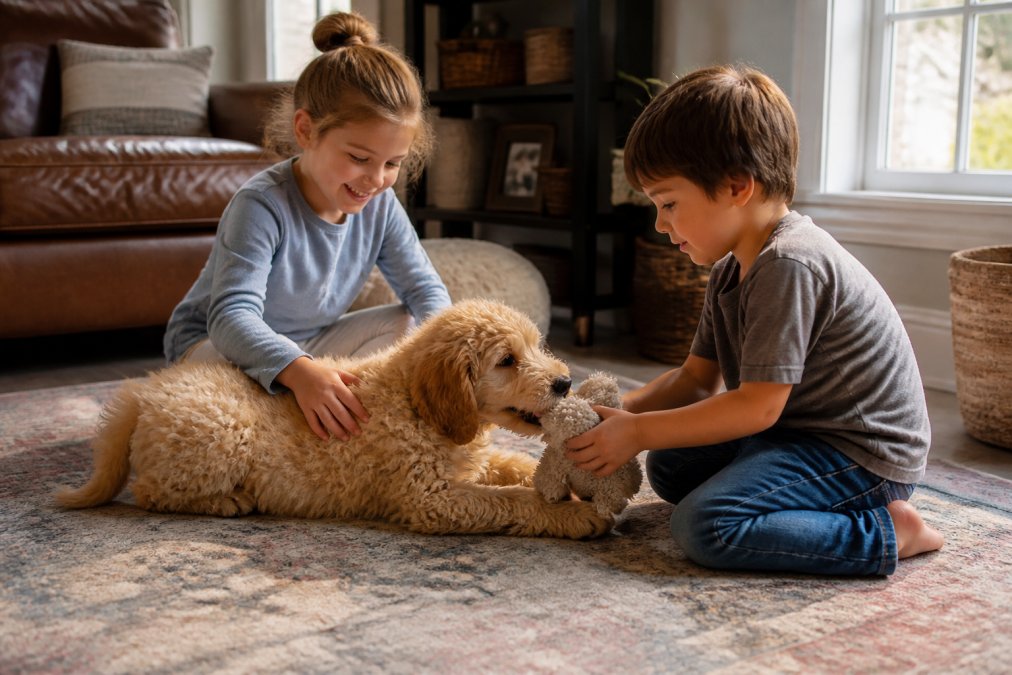
Goldendoodles inherit the Golden Retriever's affectionate nature and the Poodle's intelligence and trainability. These companion breed qualities, emotional attunement, gentleness with children, willingness to please, emerge through consistent, loving interaction during the critical first eight weeks of life.
Early Neurological Stimulation and Its Long-Term Behavioral Outcomes
Early neurological stimulation is a structured protocol developed for military working dogs and adapted for companion breed programs. It involves brief, specific exercises performed on puppies between days three and sixteen of life: gentle tactile stimulation, positional changes, and mild thermal exposure.
These exercises activate the neurological system earlier than natural development alone would allow. According to the American Veterinary Society of Animal Behavior's position statement on early socialization, puppies who receive early neurological stimulation show stronger cardiovascular performance, greater stress tolerance, and improved problem-solving ability as adults.
This requires daily, hands-on attention from a breeder who is physically present with the litter, something high-volume breeding operations cannot replicate.
Environmental Desensitization: Why Household Sounds and Routines Matter
Most behavioral problems in adult dogs trace back to one root cause: the dog was never taught that the world is safe. Environmental desensitization exposes puppies to a wide variety of stimuli, sounds, surfaces, smells, people, and routines, so novelty registers as interesting rather than threatening.
A puppy raised in a home hears the coffee maker every morning, feels carpet and hardwood under its paws, and watches people come and go through the front door. By the time that puppy leaves for its new home, none of these things are alarming. The window for the most impactful desensitization work closes around twelve weeks of age, what happens before that point is largely set by the breeder.
Hypoallergenic Qualities and the Low-Shedding Coat
Goldendoodles are not technically hypoallergenic, no dog breed is, because allergic reactions are triggered by protein in dog saliva, urine, and dander, not by hair alone. What Goldendoodles offer is a low-shedding coat that significantly reduces dander distribution around the home.
The degree of shedding depends on which coat type the puppy inherits. Puppies with a curlier, more Poodle-dominant coat shed the least. A responsible breeder can assess each puppy's likely coat type based on parental genetics and the puppy's own coat texture at eight weeks. A reputable breeder will not promise that every puppy is "completely hypoallergenic", that claim is a red flag.
Goldendoodles do require regular grooming, brushing several times per week and professional grooming every eight to twelve weeks, but they leave far less hair on furniture and floors than many other breeds.
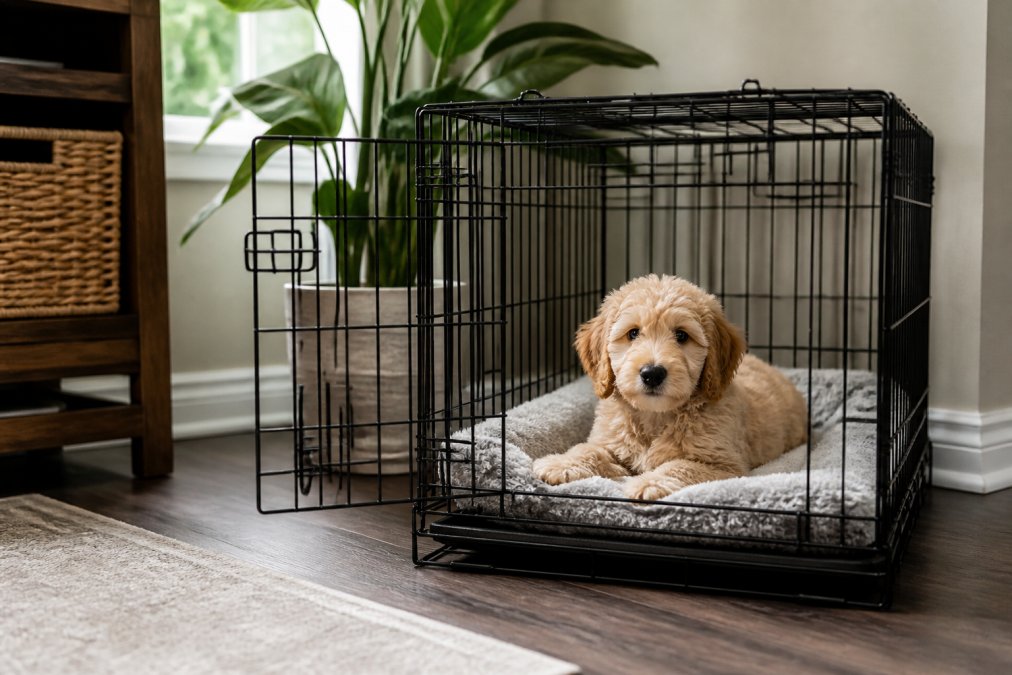
Crate Training a Goldendoodle Puppy Before You Bring Them Home
The first few weeks with a new puppy are the hardest. Most stress comes from sleep deprivation, accidents, and a puppy that cries when you leave the room. Crate training before the puppy arrives changes that dynamic significantly.

At Blue Ridge Doodles, every puppy receives three weeks of crate training before going home. The puppy already understands the crate as a safe, comfortable space, not a place of punishment or anxiety. For new owners who have never trained a puppy before, this head start is genuinely significant.
Here is what to expect when bringing home a crate-trained puppy:
- The first night is still an adjustment. Keep the crate near your bed for the first week.
- Consistency matters more than perfection. Stick to a schedule: crate after meals, crate during naps, crate at bedtime.
- Never use the crate as punishment. The goal is for the dog to choose the crate voluntarily.
- Gradually extend crate time. Most puppies adapt quickly when the foundation is already in place.
Understanding Your Goldendoodle Puppy Health Warranty
A health warranty is one of the clearest indicators of a breeder's confidence in their program. A breeder who offers no warranty, or one with so many exclusions it is effectively useless, is telling you something important about their breeding stock.
Health Screening Documentation and Genetic Testing Standards
Genetic health testing is the foundation of responsible breeding. Before two dogs are paired, a reputable breeder should have screened both parents for heritable conditions common to Golden Retrievers and Poodles: hip and elbow dysplasia, progressive retinal atrophy, and certain cardiac conditions.
According to the Orthopedic Foundation for Animals' health testing database, documented genetic screening results for breeding dogs should be publicly verifiable. When you ask a breeder for health screening documentation, you should receive actual test results, not just verbal assurance.
Blue Ridge Doodles backs each puppy with a two-year limited health warranty. Every puppy is microchipped and receives two rounds of booster vaccines before going home, along with a veterinary health certificate.
| What to Look For | Green Flag | Red Flag |
|---|---|---|
| Genetic testing | OFA or equivalent results provided | "Parents are healthy, no testing needed" |
| Health warranty | Two-year written warranty | No warranty or verbal-only assurance |
| Vaccinations | Two rounds of boosters, documented | Single vaccine or no records |
| Vet check | Certificate from licensed vet | No vet clearance before pickup |
| Microchipping | Done before puppy leaves | Left to new owner to arrange |
Questions to Ask a Goldendoodle Breeder Before You Commit
Most people approach breeder selection backwards. They look at photos, fall in love with a puppy, and ask questions as an afterthought. The questions you ask before you commit are what protect you.
Here is a checklist of what to ask any breeder:
- Can I see health testing documentation for both parents? This should be a yes with paperwork attached.
- Where are the puppies raised? "In our home" is the right answer.
- What early socialization has the litter received? Listen for specifics: neurological stimulation protocols, household exposure, handling by children.
- What does your health warranty cover, and what is the claims process? A vague answer suggests the warranty is more marketing than substance.
- Do you provide crate training before the puppy goes home? This separates breeders who invest in puppy development from those who just produce puppies.
- Can I speak with families who have adopted from previous litters? Reputable breeders welcome this.
- What support do you offer after the puppy goes home? Good breeders stay accessible.
Customer Ronda K., who adopted from Blue Ridge Doodles, observed: "It was very obvious that the puppies were loved and well cared for." That kind of observation, that the care is visible, not just claimed, is what you are looking for when you visit a breeder in person.
Why a Family-Raised Goldendoodle Is the Right Choice for Your Home
The benefits of choosing a family-raised Goldendoodle are cumulative. Each element of a home-based upbringing, early neurological stimulation, household desensitization, litter exposure, crate training, and genetic health testing, compounds into a puppy that arrives in your home ready to bond, ready to learn, and ready to fit into your family's life.
For families with young children, this means a dog that is gentle under pressure and adaptable to family unpredictability. For individuals seeking emotional support, it means a dog whose attachment style is already oriented toward humans. For allergy-sensitive households, it means a low-shedding companion whose coat type has been honestly assessed and matched to your needs.
The versatility of a well-raised Goldendoodle is remarkable. These dogs can be calm enough for apartment living and active enough for long hikes. They are intelligent enough to learn complex commands and affectionate enough to simply sit with you at the end of a hard day. That range of capability does not happen by accident, it is the product of deliberate, thoughtful puppy development from the first days of life.
As the American Kennel Club's breed information on Goldendoodles notes, the trainability of this cross makes it one of the most family-friendly options available. But trainability is a starting point, not a guarantee. What a breeder does with those first eight weeks determines how much of that potential is realized.
A family-raised Goldendoodle is not just a purchase. It is a decision about what kind of dog you want to live with for the next ten to fifteen years. Get the foundation right, and everything that follows is easier.
Choosing the right puppy is one of the most consequential decisions a family makes, and the breeder you choose shapes that outcome more than almost any other factor. Blue Ridge Doodles brings over 18 years of experience, a two-year limited health warranty, three weeks of pre-arrival crate training, and a transparent adoption process built on genuine care for every puppy and every family. Submit your application and take the first step toward welcoming a well-raised, affectionate, family-ready Goldendoodle into your home.
Frequently Asked Questions
Q: What does it mean for a Goldendoodle to be family-raised?
A: A family-raised Goldendoodle puppy grows up inside a home rather than in a kennel or outdoor facility. That means daily exposure to household sounds, children, routines, and human interaction from birth. This home-based environment shapes the puppy's temperament directly, building confidence, reducing anxiety, and making the transition to your home far smoother. Breeders who raise litters this way also have more opportunity to begin early neurological stimulation, socialization, and basic crate training before the puppy ever leaves.
Q: Is a Goldendoodle a good choice for first-time dog owners?
A: Goldendoodles consistently rank among the most manageable breeds for first-time owners. Their intelligence makes them highly responsive to positive reinforcement, and their affectionate nature means they want to please. When a puppy comes from a family-raised environment and has already started crate training, the learning curve shortens considerably. That said, consistent routines still matter, a well-socialized puppy is not a perfectly trained one, and patience in those first weeks at home makes a lasting difference in long-term behavioral health.
Q: How do I verify that a Goldendoodle breeder is genuinely family-oriented and not a puppy mill?
A: Ask for a visit or a video tour of where the puppies actually live. A trustworthy breeder will show you the whelping area, introduce you to the mother, and share veterinary clearance records and genetic health testing documentation without hesitation. Breeder transparency is the clearest signal of ethical practice. Red flags include vague answers about health warranties, refusal to share documentation, or puppies available immediately with no application process. A reputable breeder will also ask you questions, they care where their puppies go.
Q: What should a Goldendoodle puppy health warranty actually cover?
A: A meaningful health warranty covers genetic conditions for at least two years and requires documented genetic health testing of the parent dogs. It should clearly state what conditions are covered, what veterinary documentation is required to make a claim, and how the breeder responds, whether through replacement, partial refund, or support. Before signing anything, ask specifically what is excluded. A two-year limited health warranty backed by vet checks, microchipping, and booster vaccines signals a breeder who stands behind their puppies after the sale.