 ultimate-guide
Are Goldendoodles Good for Families With Toddlers?
Table of Contents
- Why Goldendoodles for Families With Toddlers Make Sense
- Do Goldendoodles Actually Shed Less Than Other Breeds?
- Safety Around Infants and Toddlers: What Parents Need to Know
- How to Socialize a Goldendoodle With Toddlers
- Goldendoodle Puppy Training Tips for Families
- Pros and Cons of Goldendoodles for Families With Young Children
- Rescue vs. Breeder: Which Is Right for a Toddler Household?
- Grooming, Maintenance, and Ownership Costs to Expect
- Frequently Asked Questions
Last Updated: August 27, 2026
Why Goldendoodles for Families With Toddlers Make Sense
Are goldendoodles good for families with toddlers? At Blue Ridge Doodles, we've spent over 18 years answering that exact question for families, and the honest answer is: yes, with the right preparation. Goldendoodles consistently rank among the most family-friendly breeds available, combining the Golden Retriever's famously gentle temperament with the Poodle's intelligence and lower-shedding coat.

Breed temperament alone doesn't determine success. How a puppy is raised before it reaches your home matters just as much. A Goldendoodle from a family-raised environment, properly socialized and crate-trained from the start, will behave very differently from one raised in an isolated kennel setting.
Temperament and Behavioral Traits That Matter Most
A Goldendoodle inherits affectionate, predictable behavior from both parent breeds. Golden Retrievers are known for low aggression and patient, gentle temperament. Poodles bring intelligence and a strong desire to please. Together, those traits produce a dog that tends to be enthusiastic but responsive to boundaries.
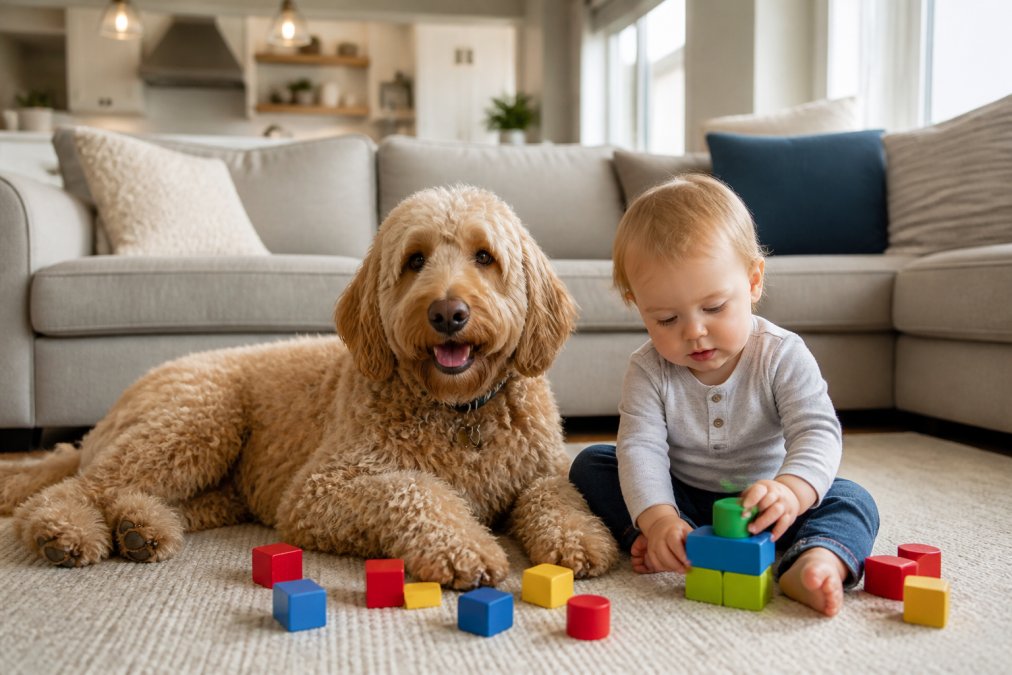
What matters most for toddler households is behavioral predictability. A dog with consistent, gentle temperament is far safer around small children than one with high prey drive or unpredictable reactions to sudden noise and movement. Goldendoodles generally tolerate the chaos of toddler life well, including shrieking, sudden hugs, and dropped toys, though no dog is completely immune to stress without proper socialization and supervision.
Early exposure to children, household sounds, and varied environments shapes how a puppy responds as it grows. A well-socialized Goldendoodle learns that toddlers are not a threat, just a slightly unpredictable part of family life.
Size Variations and What They Mean for Small Children
Goldendoodles come in three main size variations: standard, medium, and miniature. Size matters more than most families realize when toddlers are involved.
| Size | Typical Weight | Best For |
|---|---|---|
| Standard | 50-90 lbs | Active families with space, older toddlers |
| Medium | 30-50 lbs | Most family homes, good balance of energy and manageability |
| Mini | 15-30 lbs | Smaller homes, families wanting a calmer energy level |
Standard Goldendoodles carry enough weight that an enthusiastic greeting can easily knock over a toddler. Medium and mini sizes reduce that risk considerably, making them more practical for households with children under three. A medium-sized Goldendoodle often hits the sweet spot: big enough to be a real companion, small enough to be manageable around small children.
Do Goldendoodles Actually Shed Less Than Other Breeds?
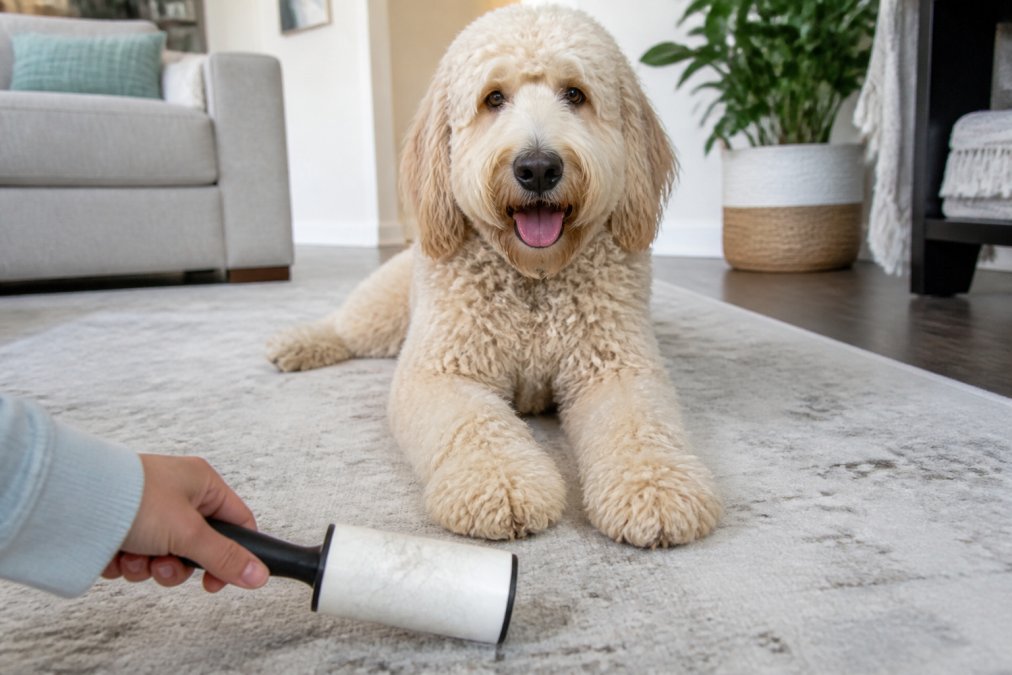
Goldendoodles do shed less than many other breeds, but the degree varies based on coat type and generation. The Poodle parent contributes a curly, hypoallergenic coat that sheds minimally. The Golden Retriever parent sheds considerably more. Depending on which genes dominate, a Goldendoodle puppy can end up with a tight curl (closer to Poodle, very low shedding), a wavy coat (moderate shedding), or a flatter coat (closer to Golden Retriever, higher shedding). F1B and F2B Goldendoodles, which have a higher proportion of Poodle genetics, are more reliably low-shedding than F1 crosses.
According to the American Kennel Club's breed information on Poodles, Poodles are among the lowest-shedding breeds recognized, which explains why doodle crossbreeds have become so popular with families managing mild allergies.
No breeder can guarantee a completely non-shedding puppy. What reputable breeders can do is select parent dogs with consistent coat traits and be transparent about the generation of the litter. If a low-shedding coat is a priority for your household, ask specifically about coat type and generation before committing.
Safety Around Infants and Toddlers: What Parents Need to Know
No dog, regardless of breed or temperament, should ever be left unsupervised with a toddler. That is a universal principle backed by the American Veterinary Medical Association's guidelines on dog bite prevention.
Goldendoodles have low aggression by nature, but even the gentlest dog can react unpredictably if startled, hurt, or cornered. Toddlers, by developmental definition, lack the impulse control to read a dog's warning signals. That combination requires adult supervision as a non-negotiable baseline.
Toddler-Specific Safety Protocols
- Create a dog-free zone. Give the dog a crate or gated space where toddlers cannot follow. Every dog needs a retreat.
- Teach "four on the floor." Train the dog not to jump before it ever meets your toddler. An enthusiastic greeting from a 40-pound dog can send a two-year-old to the floor instantly.
- Supervise all feeding. Food guarding is one of the most common triggers for dog-child incidents. Feed the dog in a separate space, away from toddlers.
- Narrate the dog's body language. Start teaching your toddler what a relaxed dog looks like versus a stressed one.
- Establish a "gentle hands" rule. Practice with the dog present so the toddler learns the behavior is consistent.
Developmental Stage Matching: Puppy Age vs. Child Age
Bringing a puppy home when your toddler is between 18 months and 2.5 years old is the most challenging scenario, because both the puppy and the child are in high-demand developmental phases simultaneously. Puppy teething peaks between 12 and 24 weeks. Toddler emotional regulation is still forming through age three. Families who wait until a child is closer to three or four years old before adding a puppy often report a smoother transition, because the child can participate in training and understands simple boundary setting.
If your toddler is currently under two, consider whether waiting six months would make the process significantly more manageable.
How to Socialize a Goldendoodle With Toddlers
Socialization is the single most important factor in how well a Goldendoodle integrates into a household with young children. A puppy that has had early exposure to children, varied sounds, and unpredictable movement will be far more settled than one that encounters these things for the first time as an adolescent dog.

The goal of socialization is positive exposure. A puppy that meets children only in chaotic or overwhelming situations may learn to associate children with stress. Structured, calm introductions where the puppy has the option to disengage are far more effective.
Practical socialization steps for toddler households:
- Start before the puppy comes home. Ask your breeder whether the litter has been exposed to children, household noise, and varied handling.
- Introduce the puppy to your toddler in a neutral space. A living room with space for the puppy to move away if needed works well.
- Keep early sessions short. Ten to fifteen minutes of calm interaction is more valuable than an hour of overstimulation.
- Reward calm behavior from both. Use treats to reinforce the puppy staying settled when the toddler approaches.
- Build up gradually. Over two to three weeks, increase the duration and complexity of interactions as both grow more comfortable.
Goldendoodle Puppy Training Tips for Families
Most first-time puppy owners underestimate how much of a toddler's experience with the family dog is shaped by early training decisions. Goldendoodles are among the most trainable breeds available, which means mistakes are rarely permanent.
Positive reinforcement is the most effective training method for Goldendoodles. This breed responds poorly to harsh corrections and thrives with reward-based training consistency. Short sessions of five to ten minutes, repeated several times a day, produce faster results than one long session. According to the American Society for the Prevention of Cruelty to Animals' training guidance, positive reinforcement builds a stronger bond between dog and owner while producing more reliable long-term behavior.
The commands that matter most in a toddler household are "sit," "stay," "off," and "leave it." Prioritize those before anything else.
Managing Energy Levels and Impulse Control
Goldendoodles have moderate to high energy levels, and puppy development means that impulse control takes time to build. A six-month-old Goldendoodle is not being bad when it bowls your toddler over. It simply has not yet learned to manage its own enthusiasm.
Activity requirements for a Goldendoodle puppy should be age-appropriate. A general guideline is five minutes of structured exercise per month of age, twice daily, until the dog is fully grown. Mental stimulation matters as much as physical activity. Puzzle feeders, training sessions, and sniff walks burn energy more efficiently than a straight run. A tired Goldendoodle is a calmer Goldendoodle, and a calmer dog is a safer dog around toddlers.
Pros and Cons of Goldendoodles for Families With Young Children
Pros:
- Gentle temperament with low aggression, well-suited to family-friendly environments
- Affectionate and bonding-oriented, which builds a strong connection with children over time
- Lower-shedding coat reduces maintenance and is better for households with mild allergies
- Highly trainable, which means behavioral issues can be addressed effectively with consistency
- Adaptable to various household sizes when the right size variation is chosen
- Predictable behavior when properly socialized and raised in a family environment
Cons:
- High energy levels during the puppy and adolescent phases require active management around toddlers
- Puppy teething can be a challenge in homes with young children
- Grooming frequency is higher than many families expect; the coat requires regular brushing and professional grooming
- Maintenance costs, including grooming, veterinary care, and training, are ongoing
- Size variations mean research is required to match the right dog to the household's physical space
- Unintentional knocking over of toddlers is a real risk with standard-sized dogs during the first year
Rescue vs. Breeder: Which Is Right for a Toddler Household?
For households with toddlers, a reputable breeder is generally the safer choice, not because rescue dogs are inferior, but because predictability matters more when young children are involved.
With a puppy from a known breeder, you have documented health history, known parentage, and ideally a transparent account of how the puppy was raised. Temperament testing can be done at the breeder's facility. You can ask specific questions about socialization history and get honest answers.
Rescue Goldendoodles are often wonderful dogs. Many doodle-specific rescue organizations do excellent temperament assessments and can match a dog to a family profile. The challenge is that the early history is often unknown. For a household with a toddler under three, an unknown history introduces more variables than most families are equipped to manage safely.
If rescue is important to your family's values, look for a doodle rescue that conducts formal temperament testing, provides a foster home assessment, and is transparent about the dog's known behavioral history.
Grooming, Maintenance, and Ownership Costs to Expect
Goldendoodle ownership comes with grooming requirements that many families underestimate before bringing a puppy home. The hypoallergenic coat that makes this breed appealing is also a coat that mats if not maintained. Most Goldendoodles need brushing several times per week and professional grooming every six to eight weeks, depending on coat type and length.
Grooming frequency is not optional. A matted coat is uncomfortable for the dog and can cause skin problems that require veterinary attention. Families should factor professional grooming into their ongoing pet ownership budget before committing.
Beyond grooming, ownership costs include routine veterinary care, vaccinations, parasite prevention, food, training classes, and supplies. At Blue Ridge Doodles, every puppy comes with a two-year limited health warranty, microchipping, and two rounds of booster vaccines, which reduces some of the uncertainty in those early months.
A puppy from a reputable breeder with 18 years of experience, a family-raised environment, and documented health practices is a meaningfully different product from a lower-cost puppy with unknown origins. As customer Ronda K. put it: "It was very obvious that the puppies were loved and well cared for." That kind of foundation shows in how a dog behaves for years after it leaves the breeder.
For families asking whether are goldendoodles good for families with toddlers, the grooming and maintenance picture is part of the honest answer. This is not a low-maintenance pet. But for families who go in with clear expectations and a realistic budget, the reward is a dog that genuinely earns its place in the household.
Raising a toddler and a puppy simultaneously is one of the more demanding things a family can take on, and it works best when the dog comes from a foundation built for exactly that purpose. Blue Ridge Doodles raises every puppy in a family environment with three weeks of crate training, full vet checks, and socialization practices designed to prepare them for real household dynamics. If you're ready to find the right match for your family, submit your application and we'll walk you through the process from there.
Frequently Asked Questions
Q: Are Goldendoodles safe around babies and toddlers?
A: Goldendoodles are generally safe around babies and toddlers because of their gentle temperament and low aggression levels. That said, no dog should be left unsupervised with a child under five. The biggest risk is unintentional knocking over, especially with standard-size dogs and enthusiastic greetings. Consistent boundary setting, early socialization, and teaching toddlers how to approach dogs calmly all reduce that risk significantly. A well-bred Goldendoodle with predictable behavior makes supervision much easier to manage.
Q: Do Goldendoodles actually shed less than other breeds?
A: Most Goldendoodles shed noticeably less than purebred Golden Retrievers, thanks to the Poodle side of the doodle crossbreed. However, shedding varies by generation and coat type. F1b and multigenerational Goldendoodles with a wavy or curly coat tend to shed the least and are more suitable for families with mild allergies. No dog is fully hypoallergenic, but a low-shedding coat does reduce the amount of dander and hair in the home. Asking your breeder about coat genetics before choosing a puppy helps set realistic expectations.
Q: Are Goldendoodles hard to potty train?
A: Goldendoodles are intelligent dogs that respond well to positive reinforcement, which makes potty training more straightforward than with many other breeds. Consistency matters more than perfection. A structured schedule, crate training from the start, and immediate praise after outdoor success are the core tools. Puppies that arrive already crate-trained have a head start. Most families see reliable results within four to eight weeks when they stick to a routine, even without prior dog-training experience.
Q: At what age do Goldendoodles calm down?
A: Most Goldendoodles move through their highest-energy puppy phase between six months and eighteen months. Full emotional maturity typically arrives around two years of age. During puppy development, activity requirements are high and impulse control is still forming, which is worth planning for in a toddler household. Daily exercise, mental stimulation, and training consistency during this window make a real difference in how the dog behaves around young children long-term.